
Description
HGH Fragment 176-191: A Targeted Research Tool for Lipid Metabolism Studies
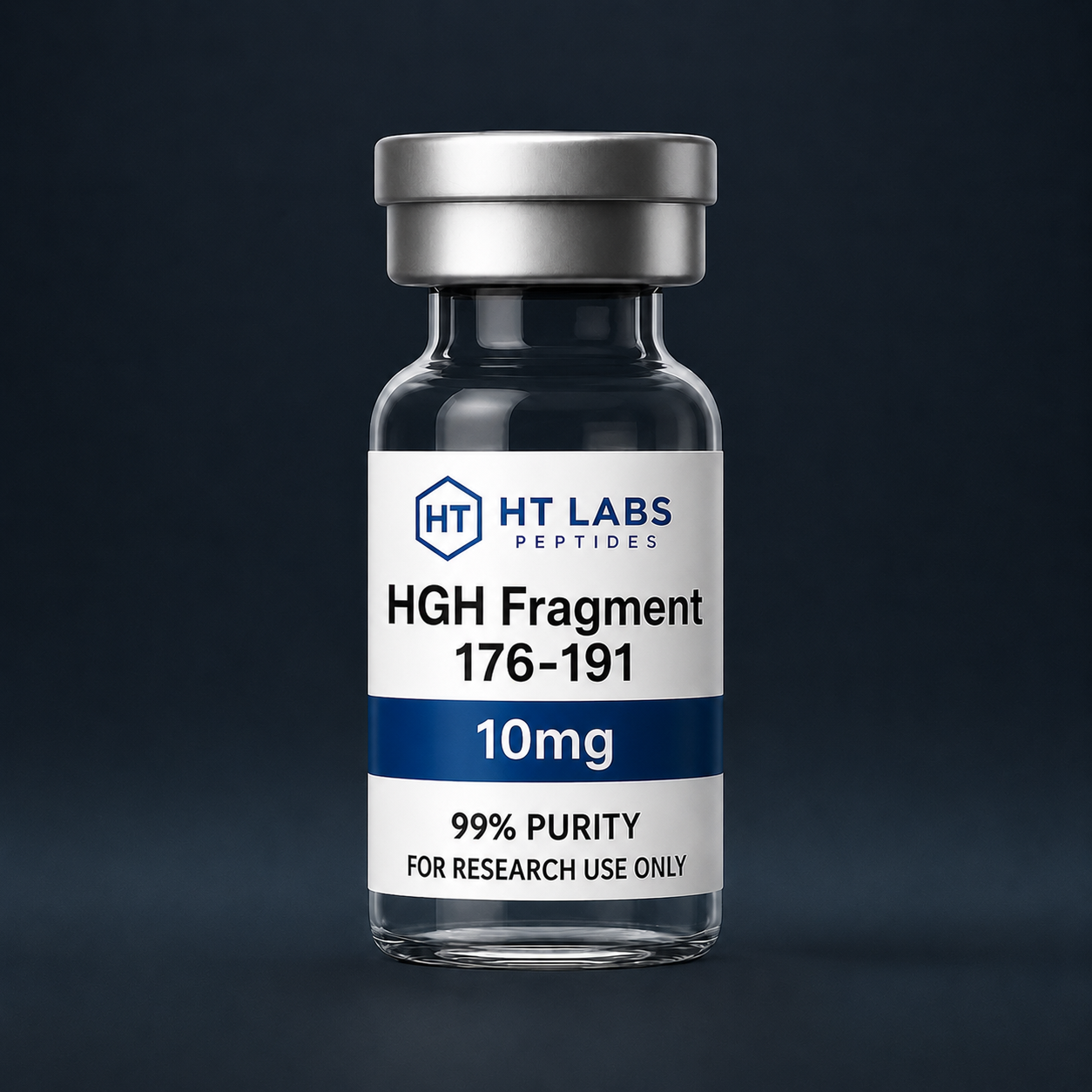
HGH Fragment 176-191, also known as AOD-9604 or simply “Frag 176-191,” represents a precisely defined segment of the human growth hormone (hGH) molecule . This synthetic peptide corresponds to amino acids 176 through 191 of the full 191-amino acid growth hormone chain, making it a focused research tool for investigating specific metabolic pathways . Unlike the complete hGH molecule, which exerts broad systemic effects, this fragment has been engineered to target lipid metabolism with remarkable selectivity.
The scientific community has directed substantial attention toward HGH Fragment 176-191 for its potential to illuminate the mechanisms underlying fat metabolism, energy expenditure, and metabolic regulation. Originally developed as a modified peptide fragment, it features the last 16 amino acids of hGH with an additional tyrosine residue at the N-terminus, a modification theorized to support the peptide’s stability and activity in laboratory settings .
This comprehensive guide explores the chemical properties, biological activities, research applications, and handling protocols for HGH Fragment 176-191. Therefore, researchers across metabolic science, endocrinology, and cellular biology will find this resource invaluable for designing rigorous experimental protocols.
Chemical Identity and Structural Properties
Molecular Characteristics
HGH Fragment 176-191 is a synthetic linear peptide consisting of 16 amino acids with a distinctive disulfide bridge between cysteine residues at positions 7 and 14 . The complete sequence is H-Tyr-Leu-Arg-Ile-Val-Gln-Cys-Arg-Ser-Val-Glu-Gly-Ser-Cys-Gly-Phe-OH, with the disulfide bridge forming a cyclic structure that is critical for its biological activity .
The compound exhibits a molecular formula of C₇₈H₁₂₃N₂₃O₂₃S₂, with a molecular weight of approximately 1815.09 g/mol . Some variations in molecular weight (1799.08 to 1859.15) have been reported depending on the salt form and specific preparation . The CAS number for the free base is 66004-57-7, which facilitates precise identification in research databases and procurement systems .
Solubility and Formulation
Understanding the solubility characteristics of HGH Fragment 176-191 is essential for successful experimental design. The peptide demonstrates good solubility in DMSO, making it suitable for various laboratory applications . Notably, the peptide does not readily dissolve in water and should be handled accordingly researchers often recommend keeping volumes small when preparing solutions .
The peptide is typically supplied as a lyophilized powder and should be stored at -20°C for long-term stability . Under these conditions, the peptide remains stable for extended periods. Once dissolved, storage at -80°C is recommended to maintain integrity and prevent degradation.
Purity and Quality Specifications
High-purity HGH Fragment 176-191 is indispensable for obtaining reproducible and reliable research outcomes. Premium-grade preparations typically exceed 98% purity as determined by HPLC analysis . Some suppliers offer material with purity greater than 99%, which ensures minimal interference from impurities or degradation products. Researchers should always verify purity specifications and request Certificates of Analysis (COAs) from suppliers to confirm product quality.
Biological Activity and Mechanism of Action
Selective Lipid Metabolism
HGH Fragment 176-191 functions as a selective modulator of lipid metabolism, targeting fat breakdown without triggering the broader hormonal activity associated with full-length growth hormone . The peptide promotes lipolysis the breakdown of stored fat while simultaneously inhibiting lipogenesis, the formation of new fat deposits . This dual action makes it a valuable tool for investigating mechanisms underlying energy balance and metabolic homeostasis.
Importantly, the fragment exerts these effects without stimulating insulin-like growth factor 1 (IGF-1) or growth hormone receptor signaling, which distinguishes it from the parent hGH molecule . This selectivity allows scientists to study domain-specific contributions to GH-related metabolic pathways in isolation.
Receptor Interaction and Signaling Pathways
Although the precise receptor interaction for HGH Fragment 176-191 has not been fully mapped, research suggests that the peptide may activate intracellular pathways related to cyclic AMP (cAMP) signaling . This pathway is commonly associated with lipid turnover and energy mobilization. Investigations propose that the peptide may support enzymes involved in lipid breakdown, selectively initiating cascades without engaging the broader GH receptor axis.
Furthermore, the fragment may interact with AMP-activated protein kinase (AMPK), a major regulator of cellular fuel status . This potential interaction positions HGH Fragment 176-191 as a compelling research tool for examining hormonal mimetics, selective metabolic triggers, and intracellular communication between nutrient-sensing systems.
Investigational Applications
Metabolic Research
One of the most extensively explored domains for HGH Fragment 176-191 is its possible impact on lipid metabolism. Investigations suggest that the peptide may encourage shifts in metabolic preference—potentially nudging cells to utilize fatty acid substrates more readily under particular conditions . Such a shift would allow scientists to observe how changes in fuel selection support cellular ATP production, mitochondrial adaptability, and broader physiological energy distribution.
In diet-induced obese models, the peptide has demonstrated significant reductions in body weight and adipose tissue, making it relevant for investigating interventions to mitigate adiposity . Studies have shown sustained fat loss aimed directly at adipose tissue, with reported 30-50% greater fat reduction compared to controls .
Cancer Research Applications
Emerging research has revealed intriguing potential for HGH Fragment 176-191 in oncology. A 2022 study published in Drug Design, Development and Therapy demonstrated that the peptide enhances the toxicity of doxorubicin-loaded chitosan nanoparticles against MCF-7 breast cancer cells . This finding suggests that the fragment may have applications in investigating targeted drug delivery systems and combination therapeutic strategies.
Regenerative and Tissue Research
Beyond metabolic regulation, HGH Fragment 176-191 has been proposed as a valuable tool for studying cellular repair and regeneration processes . The peptide is theorized to impact pathways involved in tissue healing, including cartilage repair and wound healing . Its potential to support collagen synthesis and extracellular matrix remodeling suggests utility in exploring strategies for tissue regeneration and degenerative joint conditions.
Research Applications and Experimental Considerations
In Vitro Studies
HGH Fragment 176-191 is widely employed in cell-based assays to investigate lipid metabolism, receptor signaling, and cellular responses. Researchers studying adipocyte function frequently utilize the peptide to examine its effects on lipolysis, lipogenesis, and fatty acid oxidation. The peptide’s selective action on fat cells makes it an ideal tool for dissecting the molecular mechanisms underlying fat metabolism without the confounding effects of full-length GH.
In Vivo Studies
In animal models, HGH Fragment 176-191 is administered to investigate its effects on body composition, metabolic parameters, and tissue regeneration. Studies have evaluated its impact on obesity-related metabolic disturbances, energy expenditure, and fat oxidation pathways . The peptide’s selective profile allows researchers to study isolated metabolic effects without the broader somatotropic activities typically linked with full-length GH.
Peptide Delivery Systems
Researchers have explored various delivery strategies for HGH Fragment 176-191 in laboratory settings. The peptide is commonly studied in injectable formulations, although oral and sublingual forms have also been investigated . When designing experiments, researchers should consider the peptide’s short half-life of approximately 30 minutes, which may influence dosing frequency and experimental protocols .
Important Experimental Considerations
Several factors should be carefully considered when incorporating HGH Fragment 176-191 into research protocols. First, the peptide’s solubility characteristics require appropriate solvent selection—typically DMSO for stock solutions . Additionally, the presence of the disulfide bridge makes the peptide susceptible to reduction and oxidation, necessitating careful handling and storage.
Researchers should also be aware that HGH Fragment 176-191 exists in various salt forms, including acetate and trifluoroacetic acid (TFA) salts. The TFA salt from HPLC purification contributes to the total mass of the product, with peptide content typically constituting >80% of the total weight . For most standard in vitro assays, residual TFA levels do not cause interference; however, for highly sensitive cellular or biochemical studies, researchers should be aware of its presence.
Product Specifications and Quality Control
Analytical Testing
High-quality HGH Fragment 176-191 products undergo rigorous analytical testing to verify identity, purity, and potency. High-performance liquid chromatography (HPLC) is the standard method for assessing purity, with specifications typically requiring >98% purity . Mass spectrometry confirms the correct molecular weight, and sequence analysis verifies the peptide’s amino acid composition.
Regulatory Compliance
HGH Fragment 176-191 intended for research use is subject to regulatory oversight in many jurisdictions. Products are typically designated for research purposes only, with explicit labeling indicating they are not for human or veterinary therapeutic use . The compound has not received FDA approval and is restricted by the World Anti-Doping Agency for athletic use .
Researchers must be aware of the regulatory status of HGH Fragment 176-191 in their jurisdiction and obtain institutional approval for its use in accordance with applicable laws and regulations.
Safety Information
Laboratory Safety
HGH Fragment 176-191 should be handled in a well-ventilated laboratory environment, and contact with skin, eyes, and mucous membranes should be avoided. Appropriate personal protective equipment should always be worn during handling. While the peptide itself is not classified as a hazardous substance, standard laboratory safety practices should be observed.
Stability and Storage
Maintaining the stability of HGH Fragment 176-191 requires adherence to proper storage protocols. The lyophilized powder should be stored at -20°C, where it remains stable for extended periods . For maximum recovery of product, researchers should centrifuge the original vial prior to removing the cap to ensure all material has collected at the bottom . After reconstitution, the solution should be aliquoted into single-use portions to prevent repeated freeze-thaw cycles, which can lead to loss of activity.
Summary and Research Outlook
HGH Fragment 176-191 represents a precisely targeted research tool for investigating lipid metabolism, energy regulation, and selective peptide signaling. Its ability to promote lipolysis and inhibit lipogenesis without triggering the broader hormonal effects of full-length growth hormone makes it uniquely valuable for metabolic research .
The compound’s selectivity allows scientists to decouple GH’s growth-related effects from its metabolic signals, providing a more controlled platform for exploring metabolic regulation . Furthermore, emerging applications in cancer research and tissue regeneration continue to expand the peptide’s research potential .
For researchers seeking to investigate the molecular mechanisms underlying fat metabolism, energy expenditure, and selective receptor signaling, HGH Fragment 176-191 offers a powerful and specific experimental tool. As scientific inquiry into small functional peptides expands, this fragment is steadily becoming a focal point for researchers who wish to dissect how selective molecular motifs support complex biochemical cascades within research models .
By understanding the chemical properties, biological activities, and proper handling protocols for HGH Fragment 176-191, researchers can design rigorous experiments that contribute meaningfully to our understanding of metabolic regulation and therapeutic peptide development.
Reviews
There are no reviews yet.